Evaporators · · Updated · 13 min read
Evaporator Selection Guide: Falling Film, Forced Circ., MVR
Choose between falling film, forced circulation, multiple-effect, MVR and vacuum batch evaporators for milk, juice and paste, with steam economy compared.
By the process engineering team at Supreme Beast Intelligent Machinery (Shanghai) Co., Ltd.

Key takeaways
- Falling film evaporators suit heat-sensitive, low-viscosity liquids such as milk and clear juice, with residence times of seconds rather than minutes.
- Forced circulation evaporators suit viscous, fouling or crystallizing products such as tomato paste and are often used as the final high-concentration stage.
- Adding effects cuts steam use: a two-effect plant without thermocompression uses about 0.55 kg steam per kg water, a five-effect plant about 0.2 kg.
- MVR evaporators run mainly on electricity, evaporating roughly 80–100 kg of water per kWh, and pay back where power is cheap relative to steam.
- Wiped (agitated thin) film evaporators use a rotor to spread product on a heated wall, handling viscosities up to about 10 Pa·s in standard designs in a short single pass, and are often used as a finisher after falling film effects.
Which evaporator type should you choose?
Use a falling film evaporator for heat-sensitive, low-viscosity liquids such as milk and clear juice; a forced circulation evaporator for viscous, fouling or crystallizing products such as tomato paste; multiple effects or MVR to cut energy at larger capacities; and a vacuum batch pan for small volumes, jams and frequent recipe changes.
Evaporator selection depends on four things: product viscosity at the final concentration, heat sensitivity, fouling tendency and the cost of steam versus electricity at your site. This guide compares the main designs, explains steam economy in plain numbers, and covers wiped (thin) film evaporators and falling film evaporator design. Our full range of vacuum evaporators is listed alongside.
How do the main evaporator types work?
All food evaporators boil water off under vacuum to keep product temperatures low. They differ in how the liquid moves over the heating surface: as a thin falling film, as a pumped high-velocity stream, or as a stirred batch, and in how vapour energy is reused.
Falling film evaporators
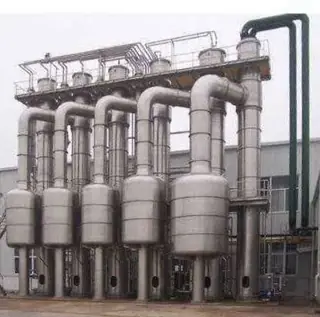
Product is distributed at the top of long vertical tubes and flows down the inside wall as a thin film while steam condenses outside. The University of Guelph dairy science text gives tube lengths of 8–12 m, diameters of 30–50 mm and residence times of 20–30 seconds, compared with 3–4 minutes in older rising-film designs. Falling film units are the most common type in dairy. Their weak point is distribution: the heating surface must stay fully wetted, or dry spots foul and burn.
Forced circulation evaporators
A circulation pump drives product through a shell-and-tube heater at a pressure above its boiling point, so it does not boil on the tubes. When it enters the separator, the pressure drops and part of the water flashes off. Because boiling happens away from the heating surface, scaling is reduced. GEA recommends this design for highly viscous liquids, products with a high fouling tendency and the high-concentration stages of multi-effect plants, often after a falling film pre-concentrator. Our forced circulation tomato paste evaporator is built for this duty.
Plate and scraped-surface evaporators
Plate evaporators spread the film over corrugated plates, giving short residence time and compact footprint; they are used for fruit juices with low solids. Scraped-surface (wiped film) units mechanically spread very viscous or heat-sensitive product in a single pass and are used for niche high-value concentrates; they are explained in detail in the wiped film evaporator section below.
Vacuum batch evaporators
A jacketed, stirred vessel under vacuum boils a fixed batch down to target concentration. Batch pans are simple and flexible, suiting jams, sauces, sweetened condensed products and pilot plants, but they give long heat exposure and no vapour reuse.
How do evaporator types compare?
Falling film offers the gentlest treatment and best energy efficiency for thin liquids, forced circulation tolerates viscosity and fouling, and batch pans offer flexibility at small scale. Most large plants combine types, for example falling film effects followed by a forced circulation finisher.
| Type | Viscosity handled | Residence time | Fouling tolerance | Typical products |
|---|---|---|---|---|
| Falling film (tubular) | Low to moderate | Short (tens of seconds per pass) | Low to moderate | Milk, whey, clear juice, plant-based milk pre-concentration |
| Plate falling / rising film | Low | Short | Low | Clear and low-solids fruit juices |
| Forced circulation | High | Longer (recirculating) | High | Tomato paste, fruit pulp concentrates, crystallizing liquids |
| Scraped surface | Very high | Very short, single pass | High | Heat-sensitive, sticky concentrates |
| Vacuum batch pan | High | Long (whole batch) | Moderate | Jam, sauces, condensed milk, small batches |
What is steam economy and how do effects and MVR change it?
Steam economy is the kilograms of water evaporated per kilogram of steam. A single effect evaporates slightly less than 1 kg per kg of steam; each additional effect reuses the vapour, so steam use per kg of water falls roughly in proportion to the number of effects. Thermocompression and MVR improve it further.
The Tetra Pak Dairy Processing Handbook gives about 0.55 kg of steam per kg of water for a two-effect evaporator without a thermocompressor, and about 0.2 kg for a five-effect plant. A thermal vapour recompressor (TVR) uses high-pressure motive steam, typically 600–1,000 kPa, to compress part of the vapour and reuse it, reducing consumption further.
| Configuration | Steam use | Electricity | Notes |
|---|---|---|---|
| Single effect | About 1 kg/kg or slightly more | Pumps only | Simple; suits small capacities |
| Two effects, no TVR | About 0.55 kg/kg | Pumps only | Handbook figure |
| Five effects, no TVR | About 0.2 kg/kg | Pumps only | Handbook figure |
| Multiple effects + TVR | Lower still | Pumps only | Needs 600–1,000 kPa motive steam |
| MVR | Start-up and make-up only | About 0.010–0.012 kWh/kg | Roughly 80–100 kg water per kWh |
In mechanical vapour recompression (MVR), a fan or compressor raises the vapour temperature by about 3–7 °C so it can reheat the same effect. The handbook states that MVR can halve operating costs compared with a six-effect thermocompression evaporator, but it raises capital cost and electrical demand. MVR makes most sense for long, continuous campaigns where electricity is competitively priced.
Which evaporator is best for milk, juice and tomato paste?
Milk: multi-effect falling film, often with TVR or MVR, operating at 40–70 °C. Clear juice: falling film or plate evaporators with aroma recovery. Tomato paste and pulpy concentrates: multi-effect forced circulation, or falling film pre-concentration followed by a forced circulation finisher.
Milk and whey
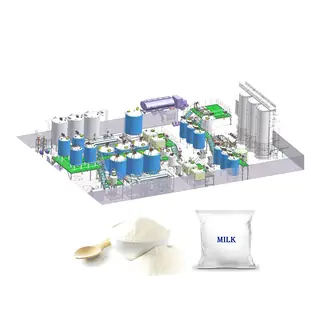
The handbook gives vacuum boiling at about 55–70 °C (160–320 hPa) with a maximum of about 70 °C in the first effect and about 40 °C in the last. Skim and whole milk are concentrated to about 48–50% total solids for condensed products, or to 32–40% as a pre-concentrate before spray drying, as in a milk powder production line.
Fruit juices
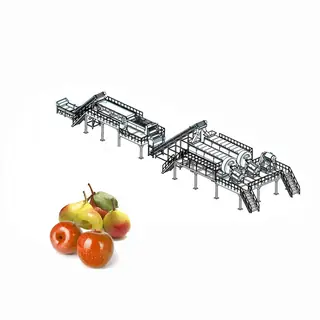
Juices are heat-sensitive and lose aroma during evaporation, so plants use short-residence falling film or plate evaporators and recover the volatile aroma fraction from the first vapours to add back later. Pulpy juices and purées need forced circulation as viscosity rises. See how the evaporator fits into a concentrated fruit juice production line and our juice production line process guide.
Tomato and fruit paste
Viscosity rises steeply as tomato juice is concentrated from about 5 °Brix towards 28–38 °Brix, so forced circulation is used for the high-concentration effects. Specialist suppliers offer dedicated forced-circulation tomato evaporators with tube-nest heat exchangers for this duty. The full process is covered in our tomato paste processing line guide, and the evaporator's share of investment in tomato paste factory cost.
Plant-based milks and other dairy-like bases
Soy, oat and other plant-based bases behave much like milk in an evaporator: they are protein-rich, heat-sensitive and prone to fouling. Where concentration is needed, for example before drying into a powder, falling film effects at low boiling temperatures with short residence time are the usual choice, followed by thorough CIP to remove protein deposits from the tube walls.
How does a wiped (thin) film evaporator work and when do you need one?
A wiped film evaporator (WFE), also called an agitated thin film evaporator, uses a motor-driven rotor to spread product as a thin, constantly renewed film on the inside of a heated vertical cylinder under vacuum. You need one when the product is too viscous, sticky or heat-sensitive for gravity-driven falling film tubes.
A falling film evaporator relies on gravity and good wetting to keep a film on the tube wall. As concentration and viscosity rise, the film thins out or breaks, dry spots foul, and heat transfer collapses. A 1997 Chemical Processing article on difficult products lists the typical failure modes of tubular evaporators with such liquids: long residence time, fouling, plugged tubes, low heat-transfer coefficients and high pressure drop. A thin film evaporator removes the dependence on gravity by forcing the film mechanically.
Wiped film evaporator working principle
- Feed and distribution: preheated feed enters near the top of the cylinder, which is held under vacuum, and is spread around the circumference of the heated wall.
- Film formation: the rotor's blades or wipers spread the liquid into a thin film and continuously renew it. Rotor designs include zero-clearance wiping blades, fixed-clearance rotors (the most common vertical type) and adjustable-clearance tapered rotors.
- Evaporation: heat from the jacket boils off water or solvent from the film; high turbulence and rapid surface renewal keep heat transfer high even as viscosity rises.
- Vapor separation and condensing: vapor leaves the evaporator body and is condensed in an external condenser connected to the vacuum system.
- Discharge: concentrate flows down and leaves the bottom after a short residence time with a narrow residence-time distribution, often reaching final concentration in one pass.
A short path evaporator is a variant built for vacuum distillation: the condenser sits inside the body, close to the evaporating surface, which minimizes pressure loss. One manufacturer specifies process pressures of 1 to 0.001 mbar for this design, used for heat-sensitive products such as vitamins, omega-3 fatty acids and flavorings.
| Criterion | Falling film | Wiped (thin) film | Short path |
|---|---|---|---|
| What moves the film | Gravity | Rotor with blades or wipers | Rotor, with internal condenser |
| Viscosity range | Low to moderate; research on falling films considers about 0.4–100 mPa·s | High; standard units up to about 100 poise (about 10 Pa·s), special rotors far higher | Low to high, for distillation duties |
| Residence time | About 20–30 seconds per pass | Seconds, single pass | Short, small product hold-up |
| Operating pressure | About 160–320 hPa in dairy duty | Vacuum, process dependent | 1 to 0.001 mbar |
| Energy reuse | Multiple effects, TVR or MVR | Usually single stage or finisher after a tubular evaporator | Single stage |
| Typical food uses | Milk, whey, clear juice, plant-based milk | Viscous or sticky concentrates, sugar solutions, lecithin, solvent stripping | Vitamins, omega-3 oils, flavorings, monoglycerides |
Sources for the table: University of Guelph and Tetra Pak handbook (falling film), Morison et al. (falling film viscosity range), Rossi et al. in Chemical Engineering Transactions and Chemical Processing (wiped film), and published manufacturer data (short path).
When does a food plant need a WFE evaporator?
- The final concentrate is so viscous or sticky that falling film tubes would run dry or plug.
- The product is high-value and heat-sensitive, so seconds of exposure matter more than steam cost.
- You need to strip a solvent or distill a heat-sensitive fraction under deep vacuum.
- Volumes are small and a multi-effect plant cannot be justified.
For bulk water removal from milk, whey and juice, a WFE is rarely the economical choice: its heating surface is small and it gives little vapor reuse. The authors of the Chemical Processing article note that a tubular evaporator combined with a thin film finisher is sometimes the best solution, letting cheap multi-effect falling film stages remove most of the water before the wiped film stage handles the viscous end. When we engineer a concentration line, our engineers flag at the design stage whether the final concentration justifies a thin film evaporation step.
How is a falling film evaporator designed?
Falling film evaporator design starts from the water to be removed per hour, then fixes boiling temperatures and the number of effects, sizes the heating surface for the usable temperature difference, and designs the distribution system so every tube stays fully wetted at the lowest flow. Vapor separators and ducts are then sized so pressure losses do not consume the temperature difference.
| Parameter | Typical value or rule | Source |
|---|---|---|
| Tube length | 8–12 m; up to 20 m where building height allows | University of Guelph; Tetra Pak handbook |
| Tube diameter | 30–50 mm | University of Guelph |
| Residence time | 20–30 s, versus 3–4 min in rising film designs | University of Guelph |
| Operating vacuum | 160–320 hPa, boiling at about 55–70 °C | Tetra Pak handbook |
| Temperature range for design | About 70 °C in the first effect to about 40 °C in the last, roughly 30 °C in total | Tetra Pak handbook |
| Losses to pressure drop and boiling point rise | 5–15 °C across a multi-effect station | Tetra Pak handbook |
| Pre-concentrator calandria | Typically 4–6 sections, each smaller than the one before | Tetra Pak handbook |
| Steam demand | Roughly total water evaporated divided by the number of effects | Tetra Pak handbook |
Design steps
- Mass balance. Water to evaporate = feed rate × (1 − feed solids ÷ product solids). For example, 10,000 kg/h at 10% solids concentrated to 50% leaves 2,000 kg/h of concentrate and 8,000 kg/h of water to remove.
- Temperature profile. Set the maximum product temperature in the first effect and the lowest practical boiling temperature in the last, which depends on cooling-water temperature. Subtract boiling point rise and pressure losses to find the usable temperature difference.
- Number of effects and vapor recompression. Split the usable temperature difference across the effects and decide on TVR or MVR from steam and power prices (see below).
- Heating surface. Each effect's area follows from its heat duty, the overall heat-transfer coefficient for the product, and its share of the temperature difference. More effects mean a smaller temperature difference per effect and therefore more surface.
- Distribution and wetting. Choose the number of tubes per section so the flow per meter of tube circumference stays above the minimum wetting rate. Morison and co-workers argue that most evaporator fouling comes from film breakdown rather than from heat transfer itself, so distribution is the most critical design detail. The Tetra Pak handbook describes distributor plates that feed each tube as a uniform film, and slight superheating of the feed so a small flash pushes the film onto the wall.
- Vapor separators and ducts. Vapor volume grows from effect to effect; undersized separators raise vapor velocity and pressure drop, which costs temperature difference and surface area.
- Cleaning and controls. Design CIP so tubes are fully wetted during cleaning as well as production, and specify level, vacuum and density control for a stable outlet concentration.
Multiple effect evaporation: how many effects?
In a multiple effect evaporator, each effect runs at a lower pressure and temperature than the one before, and its vapor heats the next. The Tetra Pak handbook gives steam use of about 0.55 kg per kg of water for two effects and about 0.2 kg for five without thermocompression, falling to about 0.32 kg and 0.09 kg respectively with a thermocompressor, and about 0.08 kg for six effects with one. Applied to the 8,000 kg/h example above, a single effect would need roughly 8,000 kg/h of steam, five effects about 1,600 kg/h, and five effects with TVR about 720 kg/h. The handbook also notes the price of extra effects: more equipment, more product hold-up and a higher first-effect temperature.
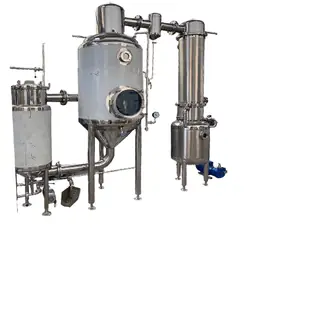
For smaller duties with fewer operating hours, a compact unit such as our milk and juice vacuum evaporator for 2–15 t/h keeps capital cost down, while long campaigns usually justify a multi-effect falling film juice evaporator with TVR or MVR. To compare scenarios, use our line planner, or ask our engineers to run the mass and energy balance for your product.
How do you specify an evaporator?
- Define feed rate, feed and target solids, and calculate water to evaporate per hour.
- Measure viscosity and fouling behaviour at the final concentration.
- Set maximum product temperature and allowable residence time.
- Compare steam and electricity prices to choose effects, TVR or MVR.
- Check cooling water temperature, which limits vacuum and the last-effect temperature.
- Plan CIP: falling film tubes need complete wetting during cleaning as well as production.
When we engineer an evaporator, we start from the water-removal duty and the product's viscosity curve, then choose the number of effects from the client's steam and power costs. Share your feed rate and target concentration and we will propose a configuration and energy estimate.
What information do you need for a quotation?
To size a vacuum evaporator we need the product and its composition, feed rate, inlet and target solids or Brix, viscosity or a sample at the final concentration, maximum allowed product temperature, steam and electricity availability and price, cooling-water temperature, and the electrical supply. These data set the water-removal duty and the number of effects.
- Product: milk, whey, clear juice, pulpy juice, tomato, plant-based milk or another liquid, with any additives.
- Capacity: feed rate in kg/h or t/day, operating hours per day and season length for fruit campaigns.
- Concentration: inlet and target total solids or °Brix, and any aroma recovery requirement.
- Product behavior: viscosity at final concentration, fouling or crystallization tendency, maximum temperature.
- Utilities: boiler steam pressure, electricity price, cooling-water temperature (critical in tropical climates), and CIP chemicals.
- Electrical supply: voltage, phase and frequency (50 or 60 Hz).
- Site: available building height (falling film tubes can be 8–12 m or longer), floor area and upstream and downstream equipment such as pasteurizers, spray dryers or aseptic fillers.
Send the details through our quotation form, by email to [email protected] or on WhatsApp at +86 18674401177. Our engineers will return a proposed configuration with steam, power and cooling-water consumption.
Frequently asked questions
What is the difference between falling film and forced circulation evaporators?
In a falling film evaporator, liquid flows down heated tubes as a thin film and boils on the tube wall, which is gentle and efficient for thin liquids. In a forced circulation evaporator, a pump keeps product under pressure in the heater so it boils in the separator, which suits viscous and fouling products.
How much steam does a multiple-effect evaporator save?
Each added effect reuses the vapour from the previous one. According to the Tetra Pak Dairy Processing Handbook, a two-effect evaporator without thermocompression uses about 0.55 kg steam per kg water, and a five-effect plant about 0.2 kg, compared with roughly 1 kg for a single effect.
Is MVR better than a steam-driven evaporator?
MVR evaporates roughly 80–100 kg of water per kWh and can halve operating cost compared with a multi-effect steam plant, but it costs more to buy and needs substantial electrical capacity. It suits large, continuous operations where electricity is cheaper than steam.
Why are evaporators operated under vacuum?
Vacuum lowers the boiling point, so water can be removed at 40–70 °C instead of 100 °C. This protects heat-sensitive proteins, colour, flavour and vitamins, reduces fouling and allows vapour from one effect to heat the next effect at a lower pressure.
What is the difference between a wiped film and a falling film evaporator?
A falling film evaporator relies on gravity to run liquid down long heated tubes, which works well for thin liquids such as milk and juice and allows multiple effects. A wiped film evaporator uses a rotor to spread and renew the film mechanically on a heated cylinder, so it handles viscous, sticky or heat-sensitive products in one short pass, but with little vapor reuse.
How is a falling film evaporator designed?
Designers start with a mass balance to find the water to remove, then set first- and last-effect boiling temperatures, choose the number of effects and any TVR or MVR, and size each heating surface. The critical detail is distribution: tubes, typically 30–50 mm in diameter and 8–12 m long, must stay fully wetted above the minimum wetting rate to avoid fouling.
What is a short path evaporator used for?
A short path evaporator is a wiped film unit with the condenser inside the body, close to the heated surface. The short vapor path minimizes pressure loss, so it can run at very low pressures, around 1 to 0.001 mbar, for vacuum distillation of heat-sensitive products such as vitamins, omega-3 oils and flavorings rather than bulk water removal.
Sources
- Tetra Pak Dairy Processing Handbook – Evaporators
- University of Guelph – Dairy Science and Technology eBook: Evaporation and Dehydration
- GEA – Falling film evaporator
- GEA – Forced circulation evaporator
- Bertuzzi – Concentration technology (evaporators for tomato and fruit juice)
- Glover & Hyde – Evaporation of Difficult Products, Chemical Processing (1997)
- Rossi et al. – First-Principles Non-Equilibrium Dynamic Modelling of Agitated Thin-Film Evaporators, Chemical Engineering Transactions 43 (2015)
- Morison, Worth & O'Dea – Minimum Wetting Rates for Falling Films (University of Canterbury, 2006)
- SMS – Short path evaporator (technical description)