Insights · · 9 min read
Yogurt Production Line Guide
How a yogurt production line works: milk reception, pasteurization, fermentation, filling and cold chain — plus sizing and what to ask before you buy.
By the process engineering team at Supreme Beast Intelligent Machinery (Shanghai) Co., Ltd.
In short
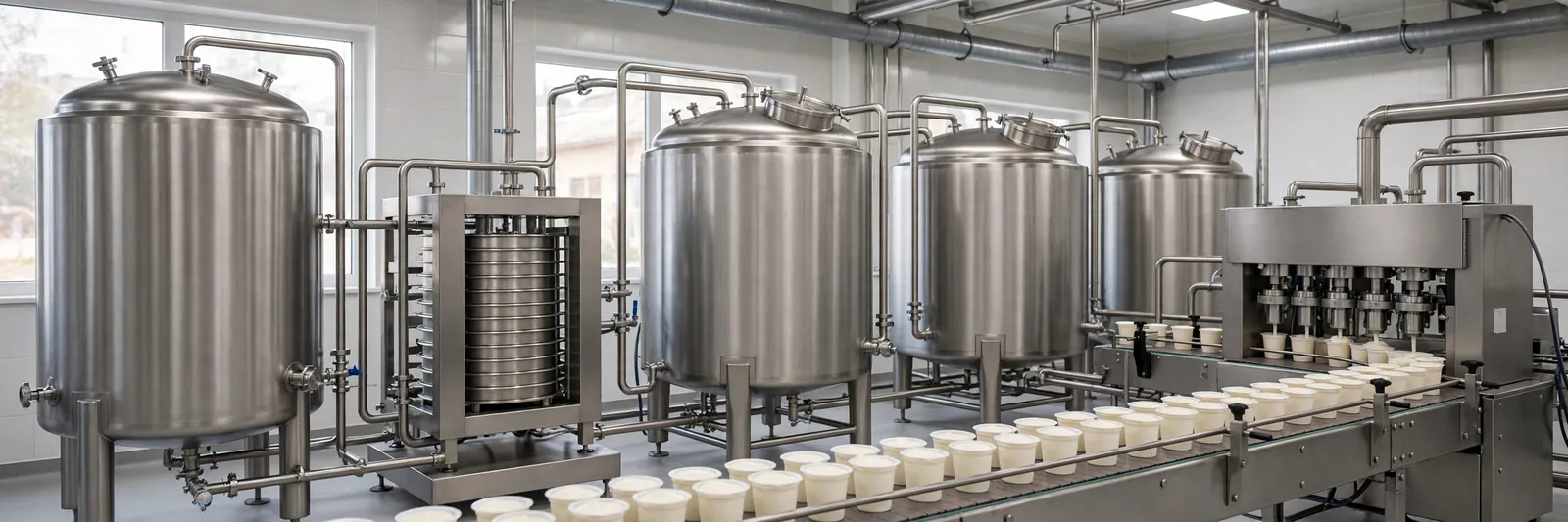
A yogurt production line takes in raw milk and sends out filled, chilled cups: reception and storage, pasteurization and homogenization, fermentation, cooling, filling and cold storage, with cleaning built into every step. The product you want — set or stirred — decides the fermentation setup, and your daily volume decides the size of every machine after it.
What does a yogurt line actually include?
A yogurt line moves milk in one direction — reception, heat treatment, fermentation, cooling, filling and cold storage — with a cleaning circuit on every part the product touches.
The chain itself is short. Milk arrives and is pumped into a chilled storage tank. A plate pasteurizer heats it, a homogenizer evens out the fat, and the milk is cooled to culture temperature. Then comes fermentation — in tanks, or in the cups themselves — followed by cooling, filling, sealing and cold storage. Tanks and pipework are food-grade stainless steel; on our lines that means SUS304. The filler sets the pace, deciding how many cups leave per hour.
Set yogurt or stirred yogurt — decide this first
The choice changes the line more than any other decision. Set yogurt is filled first and ferments in the cup, so the line needs an incubation chamber and a chiller for filled cups. Stirred yogurt ferments in a tank and is filled after cooling, so the line needs insulated tanks and a plate cooler instead. The reception and heat-treatment end is the same either way — so buyers who plan to sell both should say so before the layout is drawn: the fermentation area is the hardest part to rebuild.
Some plants add one more step at the end: freeze-dried yogurt bites. A freeze dryer can sit beside the yogurt line and take its output — our QS-FD-20 takes about 200 kg per batch, the QS-FD-100 about 1 tonne, and the QS-FD-200 about 2 tonnes. It is an add-on, not part of the yogurt line, and it only makes sense once the fresh-yogurt line runs well.
How does milk become yogurt on a line?
Milk arrives, is checked and chilled, then heated, homogenized, cooled, cultured, fermented, cooled again and filled. Every step has a job; skipping one shows up in the texture or the keeping quality.
- Reception: raw milk arrives, is checked and pumped into a chilled storage tank at about 4 °C.
- Heat treatment: the milk is heated to 90–95 °C for about 5 minutes, which also sets the milk protein so the gel firms up.
- Homogenization: the hot milk passes through a homogenizer at 200–250 bar, breaking the fat into small, even droplets.
- Cooling and culture: the milk is cooled to 40–45 °C and dosed with culture while the fermentation tank fills.
- Fermentation: stirred yogurt rests in the tank at 42–43 °C for about 4–5 hours until pH 4.2–4.5; set yogurt is filled into cups first and spends about 3–3.5 hours in the incubation chamber.
- Cooling: stirred yogurt passes through a plate cooler down to 15–22 °C; set yogurt is chilled to about 5 °C.
- Filling and packing: cups are filled, sealed, date-coded and packed — stirred yogurt after cooling, set yogurt before incubation.
- Cold storage: finished cups go straight into the cold room and stay chilled through dispatch.
The temperatures and times above come from the Tetra Pak Dairy Processing Handbook, as cited in our fermentation tank guide. Your milk and recipe will move them, so confirm them on a test batch before you fix the size of any machine.
How do you size a line from your daily volume?
Start with litres per day, take away the hours cleaning and changeovers eat, and size every machine from the hourly flow that is left. A line sized from the daily average will queue at its smallest machine.
The method works for any volume. Divide the daily volume by the effective production hours — the shift length minus cleaning, start-up and changeovers, often one to two hours a day less. That gives the hourly flow, and the pasteurizer, homogenizer and cooler are sized to it with headroom. Fermentation is different: tanks are sized from the batch cycle — fill, ferment, cool out, clean — so the number of tanks follows from how many batches a day the schedule needs. Two tanks — one cleaned while the other runs — is the usual answer, with a buffer tank between the batch and continuous steps.
Pack formats change the arithmetic too: a filler rated in cups per minute makes far fewer litres per hour in 100 g cups than in 1 kg tubs, so state the pack sizes with the volume. Plan for growth the cheap way — floor space and pipe connections left ready cost little now and save a rebuild later.
Why does fermentation decide the texture?
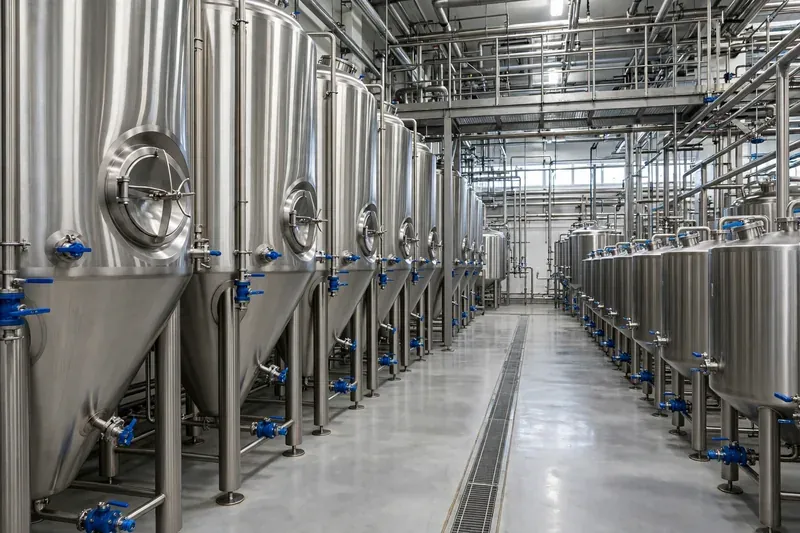
Fermentation is the quiet step that makes or breaks the cup: temperature held steady, the gel left alone, the batch cooled at the right acidity. Get it wrong and no filler or package can fix it.
Stirred yogurt ferments in an insulated tank with a low-shear agitator, at 42–43 °C for about 4–5 hours, until the batch reaches pH 4.2–4.5. The agitator matters: stir the gel hard and it breaks, and the yogurt comes out thin. When the pH is right, the batch goes through a plate cooler down to 15–22 °C — a cooler sized to empty a tank in about 30 minutes keeps the line moving.
Set yogurt takes the other path: the cultured milk is filled into cups, the cups spend about 3–3.5 hours in the incubation chamber, and then they are chilled to about 5 °C. Here the cup is the fermenter, so the chamber and the chiller set the pace of the line, and the cups must move without shaking once the gel has set.
One detail buyers often miss: the fermentation loop needs its own cleaning circuit. Culture residue builds up fast in a warm tank, and sharing a circuit with the raw-milk side is how contamination travels. Ask any supplier whether the fermentation tanks have a dedicated CIP loop — a vague answer means the quotation is unfinished.
What happens at filling, cold chain and CIP?
Filling is where the product meets the package, and the cold chain starts the moment the cup is sealed. Cleaning is what lets you run tomorrow.
The filler is the last machine that touches the product, and its place in the layout depends on the yogurt type. Stirred yogurt is filled after cooling, so the filler sits at the end of the line; set yogurt is filled before incubation, so the filler sits in the middle, with the chamber and the chiller after it. Either way the same parts follow: cup de-stacking, filling, sealing, date coding and packing into cartons.
From the filler, the cups go straight into the cold room. The cold chain is not a separate system — it is the filler, the cold room and the dispatch dock working as one, and any wait at room temperature between them costs keeping quality. Put the cold room next to the filler.
Cleaning runs through the whole line. Every product-contact circuit is cleaned in place between runs: the reception and heat-treatment loop, the fermentation loop on its own circuit, and the filler. Water, drainage and chemical handling are planned with the layout, not added after it — a line with nowhere for the cleaning water to go stops.
What should you ask before you buy?
A short checklist before you sign: if a supplier cannot answer these in writing, the quotation is not complete.
- Product list and volumes — which yogurt types the line runs, and the daily volume for year one and year five, with pack formats.
- What changes between products — set, stirred and drinking yogurt on one line means different fermentation paths; the quotation should say what is shared.
- Site utilities — steam or hot water, chilled water, power, water and drainage your site can supply, against what the line needs at peak load.
- Materials and cleaning — food-grade stainless steel throughout, and a CIP circuit for every product-contact loop, fermentation included.
- Delivery scope in writing — machines, tanks, pipework, installation, commissioning, training and spares.
- Commercial terms — lead time about 3 months, FOB Shanghai, 50% deposit and 50% before shipment, and a 12-month warranty.
Send us your product list, daily volume and pack formats and we will reply with a flow diagram, equipment list and quotation. Equipment specifications and capacities in this guide are for reference only; confirm the final configuration in your quotation.
Frequently asked questions
Set or stirred — which yogurt should my line make?
It depends on the product you sell. Set yogurt ferments in the cup — about 3–3.5 hours in an incubation chamber, then chilled to about 5 °C. Stirred yogurt ferments in an insulated tank at 42–43 °C for about 4–5 hours, then cools through a plate cooler to 15–22 °C before filling. If you plan to sell both, say so before the line is drawn: the fermentation area is different for each.
How much milk per day makes a line worth it?
There is no single minimum. What matters is your daily volume, your pack formats and how many hours a day the line runs after cleaning. Share those three numbers and we size the line to them — a small line with the right filler beats a big line that waits for milk.
What utilities does a yogurt line need?
Hot water or steam for heating and cleaning, chilled water for cooling, refrigeration for the cold room, compressed air for valves and the filler, plus water and drainage sized for CIP. Each one is sized from the peak load, not the daily average.
How long does it take from order to first production?
Lead time is about 3 months from order, FOB Shanghai port, with 50% deposit and 50% before shipment and a 12-month warranty. Installation and commissioning by our engineers on site follows delivery, with operator training included.
Can one line make both set and stirred yogurt?
Yes, if it is planned that way. Reception, pasteurization and homogenization are shared; the fermentation paths split — cups and an incubation chamber for set, insulated tanks and a plate cooler for stirred. A CIP cycle and a changeover sit between the two runs.