Insights · · 9 min read
Coconut Milk Production Line Guide
How a coconut milk production line works: grating, pressing, heat treatment and filling — and how to size one from your nut supply.
By the process engineering team at Supreme Beast Intelligent Machinery (Shanghai) Co., Ltd.
In short
A coconut milk line turns fresh nuts — or dried flakes — into milk, then heats it and fills it into cartons, cans or pouches. The front of the line depends on which raw material you start with; everything after pressing is much the same. Size the line from your daily nut supply, not from a litre-per-hour figure.
Fresh coconut or desiccated — which line do you need?
Fresh coconut and desiccated coconut need different front ends — pick your raw material before you pick a machine.
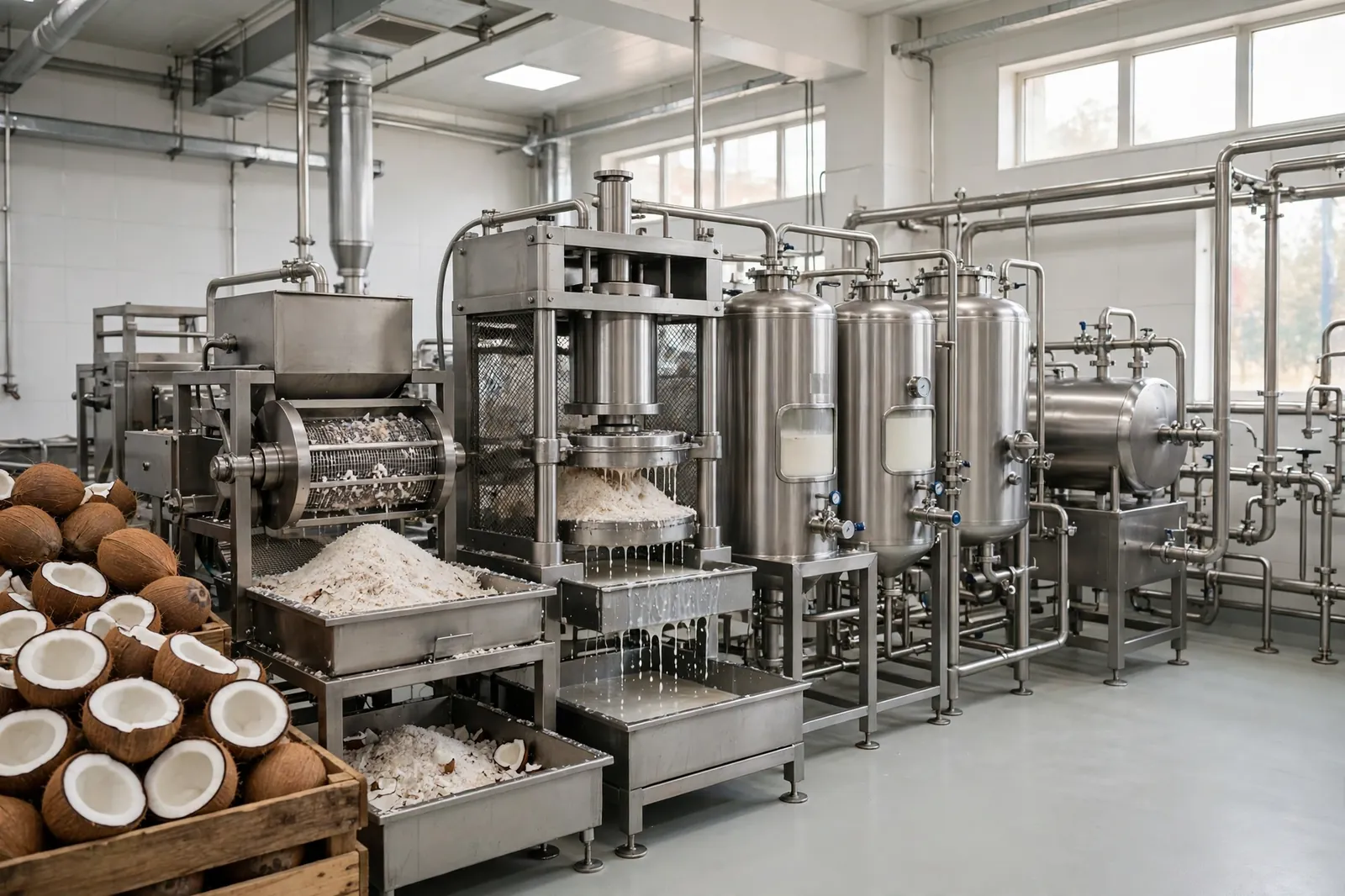
On the fresh route, nuts arrive whole. They are de-husked, split, pared of the brown skin, grated, and pressed. That takes a nut-handling area, labour or machines for splitting, and somewhere for the husks and shells to go — they pile up fast. The meat itself sets the pace: once a nut is opened, the meat has to be processed soon, so intake, grating and pressing run on the same shift, not the next day.
On the desiccated route, dried flakes arrive in bags. Rehydrate, press, done. There is no de-husking, no splitting, no shell waste, and the raw material keeps on a shelf instead of arriving in truckloads that spoil. The trade is that you pay someone else to do the drying, and the flavour is not quite the same as milk pressed from fresh meat. Buyers who sell on fresh taste notice.
Everything after the press — separation, heating, homogenizing, filling — is the same either way. That is why the first question in any serious conversation about a coconut milk line is always about the nut: fresh or dried, how many a day, and how steady the supply runs through the year.
How does the extraction chain work?
Grating, pressing and separation decide how much milk you get from each nut — and what fat content it comes out at.
Grating
The meat is grated fine and even, because surface area is what lets the press work. A coarse or uneven grate leaves milk in the fibre. Judge a grater the way you would judge any cutting machine: even output, easy cleaning, and a screen size you can change when the nut changes.
Pressing
A screw press or hydraulic press squeezes the milk out of the grated meat. The first press, with little or no added water, gives the richest milk. A second press, with hot water added, pulls out more volume at a lower fat content. The water you add here is not a detail — it sets the fat content of the finished milk, which is why the target fat content has to be agreed in writing before the line is sized. A line built for rich cream and a line built for thin drinking milk press differently.
Separation
The pressed milk still carries fine fibre. A centrifuge or a fine screen takes it out, and the spent meal left behind needs a plan of its own — animal feed, compost, or drying for sale. It is wet, it is heavy, and it turns quickly, so the disposal route has to be ready before start-up, not found after the first week.
What do heat treatment and homogenization do?
Coconut milk separates if you leave it alone — heat treatment and homogenizing are what keep it saleable.
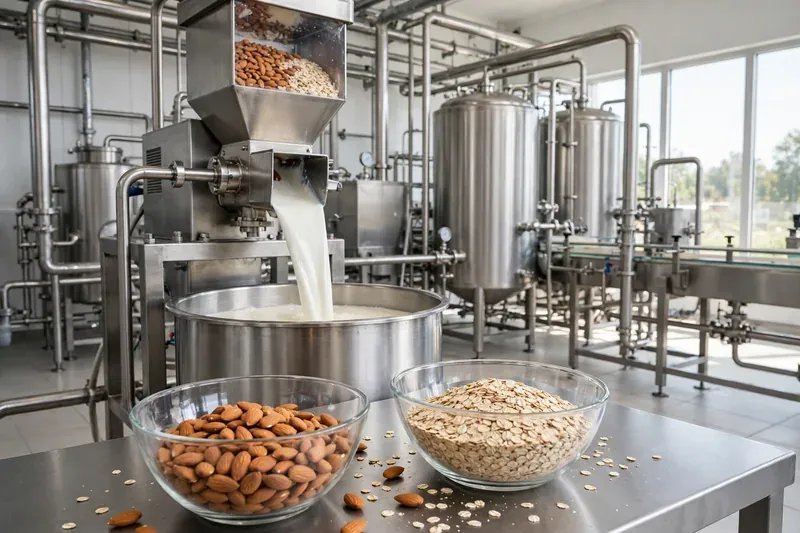
Homogenizing comes first, in the usual order. It breaks the fat into droplets small enough to stay mixed instead of rising to the top of the carton. Without it, the customer opens a carton with a layer of cream on top and thinks the product has gone off. The homogenizer is one of the machines you size with headroom — it is a common bottleneck.
Heat treatment comes next, and the choice is the same one every plant-based milk maker faces. UHT runs at 135–150 °C for a few seconds, then the milk goes into cartons aseptically — that is the route to months of ambient shelf life, and it is the figure the Tetra Pak Dairy Processing Handbook gives. Pasteurizing suits chilled sale instead, with a cold chain behind it. Either way, run trials: too much heat gives the milk a cooked note, and coconut shows it more than most.
Cleaning runs through both steps. Every product-contact circuit is cleaned in place between runs, and the line stops for it — count on losing an hour or two a day to cleaning, start-up and changeovers when you work out your real output.
Which filling format fits your market?
Cartons, cans and pouches are three different fillers — choose the format before you price the line.
UHT cartons
UHT cartons are the retail standard: aseptic cartons, filled aseptically after UHT, sold at ambient temperature. The filler is a serious machine, often the most expensive single item after the UHT unit, and it only fills cartons — it will not fill anything else later.
Cans
Cans suit ingredient buyers and food service. The milk is filled, the can is sealed, and the sealed can is heated. The line needs a filler and a seamer, and the cans themselves are heavy to ship — check freight before you fall in love with the format.
Pouches
Pouches are the cheapest way in: lower machine cost, smaller runs, handy for food service and for buyers testing a new product. The seal has to hold against an oily product, so test your actual pouch and your actual milk, not a sample from a trade show.
Naming is part of the format decision too. In the EU, plant-based drinks generally cannot be sold under the word “milk” after the Court of Justice ruling C-422/16 (2017), so cartons there usually read “coconut drink”. Check the label rules in each market you plan to sell into before the cartons are printed.
How do you size a line from your nut supply?
Start from the nuts, not the catalogue: daily nut intake decides the size of everything downstream.
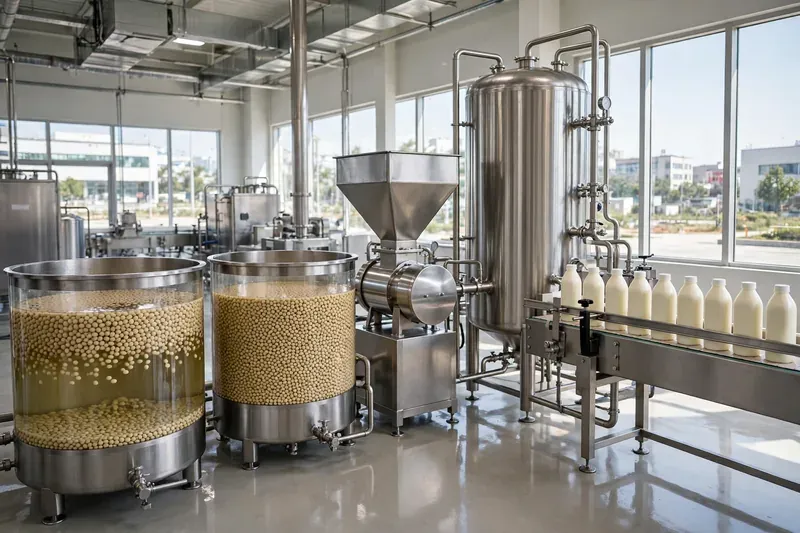
A coconut milk line is sized backwards. How many nuts arrive a day, on a good day and on a bad one? Coconut supply is seasonal and it depends on weather and transport, so size for the intake you actually get, not the intake you hope for. The only honest way to fix the numbers is a trial: send your nuts, run them through the press, measure what comes out. Any supplier who sizes your line without a trial is guessing.
From the trial you get the real figures: how much milk per day, at what fat content, in how many hours. Then convert to hourly flow the way every line is sized — daily volume divided by effective production hours, the hours left after cleaning and changeovers. Size the bottleneck — usually the press, the homogenizer or the UHT unit — with 10–20% headroom, so the line is not running flat out on a normal day.
Buffers matter as much as machines. A tank that lets intake continue while the line is being cleaned, and a second tank where one must be cleaned while the other runs, keep the line from queuing at its smallest machine. Floor space for one more tank is cheap at the planning stage and expensive later.
What should a supplier’s proposal include?
A good proposal reads like a plan for your factory, not a price list for machines.
Ask for the flow diagram first — every step from nut intake to packed carton, with a machine against each step. Then the equipment list with capacities stated at your recipe and your nut, not a brochure figure. Then utilities: steam or electric heat, water quality, and the voltage and frequency on your site (50 or 60 Hz). Then the parts people forget to ask about: installation and commissioning by the supplier’s engineers, operator training, spare parts, and cleaning — every product-contact circuit cleaned in place.
Commercial terms belong in the same document. Ours are a lead time of about 3 months from order, FOB Shanghai port, payment 50% deposit and 50% before shipment, and a 12-month warranty. If a proposal leaves any of those out, ask — a missing term is not a saving, it is an argument waiting to happen.
Equipment specifications and capacities in this guide are for reference only; confirm the final configuration in your quotation. Before you ask for a price, write down your coconut supply and your target fat content, and send both with the enquiry. A supplier who has those two facts can size your line; a supplier who has not will send you a catalogue.
Frequently asked questions
Can one line handle both fresh coconut and desiccated coconut?
The back half can — separation, heating, homogenizing and filling are the same. The front end cannot: fresh nuts need de-husking, splitting and grating, while desiccated flakes need rehydrating. If you want both, budget for two front ends feeding one shared back end.
What fat content should my coconut milk have?
It depends on your buyer — cooking cream, drinking milk and barista-style drinks all sit at different levels, and the label rules differ by market. Agree the target in writing before the line is sized, because it changes how much water goes in at the press and how the separation stage is set up.
UHT or pasteurized — which should I choose?
UHT at 135–150 °C for a few seconds, filled aseptically, gives months of ambient shelf life and suits retail cartons. Pasteurizing suits chilled sale with a cold chain behind it. The choice follows your market and distribution, not the machine — decide it before you price the filler.
How long does it take from order to running production?
Lead time is about 3 months from order, FOB Shanghai port. Installation and commissioning by our engineers on site follows delivery, with operator training included.
What information do you need for a first quotation?
Your raw material — fresh nuts or desiccated, and how many a day — your target fat content, pack formats, power supply and any plant drawings you have. We reply with a flow diagram, equipment list and priced proposal.