Insights · · 9 min read
Carbonated Beverage Line Guide
A carbonated beverage line mixes syrup with treated water, carbonates it cold, and fills bottles or cans without losing the fizz — how each step works.
By the process engineering team at Supreme Beast Intelligent Machinery (Shanghai) Co., Ltd.
In short
A carbonated beverage line turns treated water and syrup into a fizzy drink. The chain runs water treatment, syrup mixing, carbonation, filling and packing. Three things decide whether a line fits your plant: the water you start with, the pack you sell, and the hourly volume you need. Get those right and the machines follow.
What makes a carbonated line different from a juice line?
A juice line and a carbonated line share a lot of hardware — but only a carbonated line has to keep gas dissolved in the drink until the cap or the seam closes, and that one requirement changes the filler, the piping and the chilling.
A juice filler pours liquid into an open bottle and the job is done. A carbonated filler works against pressure: the bottle is pressurised with gas first, filled while the gas has nowhere to escape, and capped the moment it leaves the filler. If any step is slow or leaky, the drink arrives at the shelf flat, and no extra gas at the carbonator will fix it afterwards.
That is why pricing a carbonated line as a juice line with a carbonator added on usually ends short. The filler is a different machine, the capper has to work faster and tighter, and the product has to arrive at the filler cold. The recipe differs too: a carbonated drink is water, sugar or sweetener, flavour and gas, mixed in the syrup room. The machines look familiar; the process is not.
Water treatment first — the step buyers underestimate
Your water report decides the treatment package before any machine is sized, because water is the first ingredient and most of what is inside the bottle.
Two plants in the same city can need different treatment. One draws municipal water with chlorine that has to come out before it touches flavour; the other draws from a borehole with hardness that leaves scale in the heater and a taste in the drink. The report tells the supplier which problem to solve, and guessing wrong means the finished drink tastes different from the sample the buyer approved.
A typical chain runs filtration, then a carbon filter for chlorine and off-tastes, then softening or reverse osmosis depending on the report, then a treated-water tank feeding the rest of the line. Which stages your plant needs comes from the report, not from a standard package — and the treatment has to handle the worst month of the year, not the average. Send the report with your first enquiry.
The syrup room and mixing
The syrup room is where the recipe is made, and it deserves its own clean room and its own discipline — a small error here is bottled hundreds of times an hour.
Sugar is dissolved in treated water, flavour and acid are added, and the syrup is mixed until it is even through the whole tank. That syrup is then dosed into the treated water stream at a set ratio as the line runs, and the dosing has to stay steady while the line speeds up and slows down.
Most plants run two syrup tanks: one feeding the line while the next batch mixes, so the filler never waits and a batch that needs a correction can be fixed in the tank instead of on the line. Keep the room separate from the filling hall. Syrup is sticky, sweet and warm — exactly what microbes like — so every tank, pipe and valve needs a cleaning connection. If you change flavours often, ask how the room handles it: a flavour change means the tanks, dosing pump and pipes all need flushing first.
Carbonation and filling: keeping the fizz in the bottle
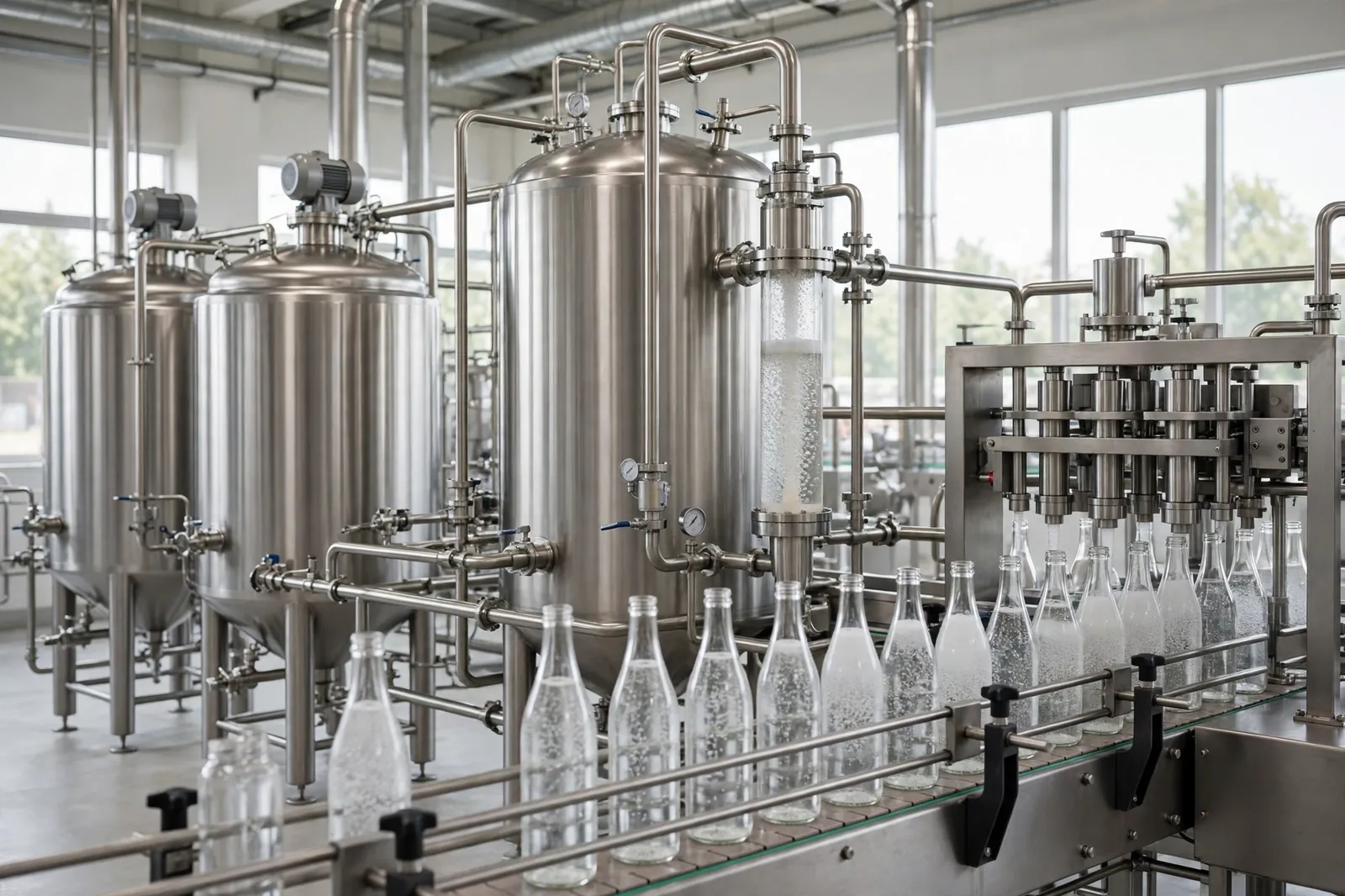
Carbonation only holds if the product is chilled before it reaches the carbonator — warm liquid will not hold gas, and a warm bottle loses its fizz no matter how much gas you push in upstream.
The drink is cooled first, then it passes through the carbonator, where gas is mixed in under pressure. From there it goes straight to the filler with no warm stops in between: no long pipe run through a hot hall, no open buffer tank. Every metre between the carbonator and the filler is a chance for gas to come out, so that run stays short and cold.
The filler is a counter-pressure filler. Each bottle is pressurised with gas before filling starts, so the drink flows in without the gas in the drink escaping into an empty bottle, and the bottle is capped at once — the cap is part of the carbonation, not an afterthought. When a line loses fizz, check temperature first, not the carbonator settings: a chiller that cannot keep up on a hot afternoon will show up as flat bottles, and the gas settings usually turn out to have been right all along.
Bottle vs can — what changes on the line
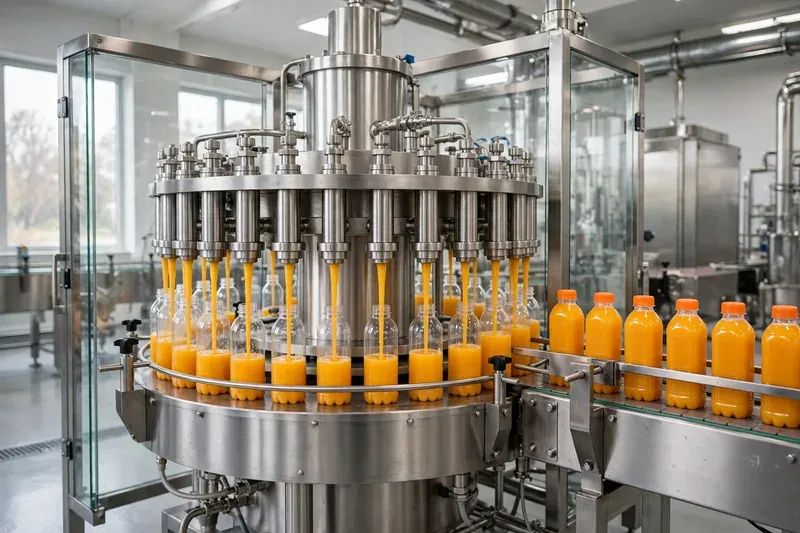
Bottles and cans share the water, syrup and carbonation stages, then split: a bottle needs a capper and a labeller, a can needs a seamer, and the filler itself is a different machine for each.
A bottle line runs through a rinser, a filler, a capper and a labeller, then into the packer. A can line runs through a rinser, a filler and a seamer, and the can usually carries its print already, so there is no labeller. Conveying changes too: cans are light and tip easily, so the guides, transfers and accumulation tables are built for them.
Change parts cover different sizes inside one pack type — a small bottle and a large bottle on the same filler, for example. They do not turn a bottle line into a can line. Decide your main pack before you order anything: the mixing and carbonation stages can be sized for both, but the filling end is bought twice unless the plan allows for it.
Utilities, cleaning and changeover
Chilled water is the utility that decides whether a carbonated line works: carbonation needs a cold product, so the refrigeration load is sized from the hottest day and the fastest hour, not the average.
Alongside it the line needs power, compressed air for the valves and the filler, steam or hot water for cleaning, and drainage that can take the full cleaning flow. Each one is sized from the peak moment when several machines draw at once. A plant that sizes utilities from the daily average will find its chiller short on the first hot afternoon.
Cleaning runs through everything the product touches: syrup tanks, mixer, carbonator, filler, pipes and valves. Every one of those needs a cleaning connection that reaches the same places the product reaches. Changeover time belongs in the hourly target too: a line that changes flavour twice a day spends real hours flushing the syrup system and the filler, and those hours come out of production.
Common mistakes buyers make
Most carbonated line problems are decided before the first machine is ordered: the water was assumed, the pack was undecided, and the capacity was counted without cleaning and changeover.
First, sizing from the best day. A line quoted for the fastest hour on the coolest day will not hold that speed in summer, after a flavour change, or at the end of a long shift. Size from a normal production day, cleaning and changeovers already taken out.
Second, treating water as an afterthought. Buyers forget the water report, the treatment package is guessed, and the fix is a second unit ordered in a hurry. Third, ordering the filler before the pack is decided: a filler bought for bottles cannot fill cans, and a capper cannot become a seamer.
Fourth, buying on the lowest machine price with an undersized chiller and carbonator. The filler gets the attention as the biggest machine in the hall; the chiller gets forgotten because it sits outside. But a warm product makes flat drinks, and no filler can fix that.
Start with two things: your water report and your target bottle or can size. Send those with your product list and hourly volume, and ask for a flow diagram and a quotation in return — lead time is about 3 months from order, FOB Shanghai, payment 50% deposit and 50% before shipment, with a 1-year warranty. Equipment specifications and capacities in this guide are for reference only; confirm the final configuration in your quotation.
Frequently asked questions
Can the same line make still drinks and carbonated drinks?
Yes, in separate batches. The carbonator can be bypassed and the same filler used for still drinks, but the line needs a full flush and clean between a carbonated run and a still run, and the change takes time out of the schedule. If still drinks are a large share of your volume, say so at the start so the changeover is planned into the line, not discovered on the first production day.
Why does my drink lose its fizz after filling?
Check the product temperature first. Gas only stays dissolved in a cold drink, so a chiller that cannot keep up, a warm product tank or a long pipe run between the carbonator and the filler will all show up as flat bottles. After temperature, check the cap or the seam: a cap that seals badly loses gas slowly, and the complaint arrives weeks later from a shop shelf.
Can one line fill both bottles and cans?
Not without different filling equipment. Change parts cover different sizes inside one pack type, but a bottle line and a can line use a different filler, and a capper is not a seamer. Decide your main pack before ordering; the water, syrup and carbonation stages can be sized for both, but the filling end is bought twice unless the plan allows for it from the start.
What do you need for a first quotation?
Your product list, bottle or can size, hourly volume, water report, power supply and any plant drawings you have. We reply with a flow diagram, equipment list and priced proposal. Our terms are: lead time about 3 months from order, FOB Shanghai, payment 50% deposit and 50% before shipment, and a 1-year warranty.
How long does it take from order to running production?
Lead time is about 3 months from order, FOB Shanghai. Installation and commissioning by our engineers on site follows delivery, with operator training included.